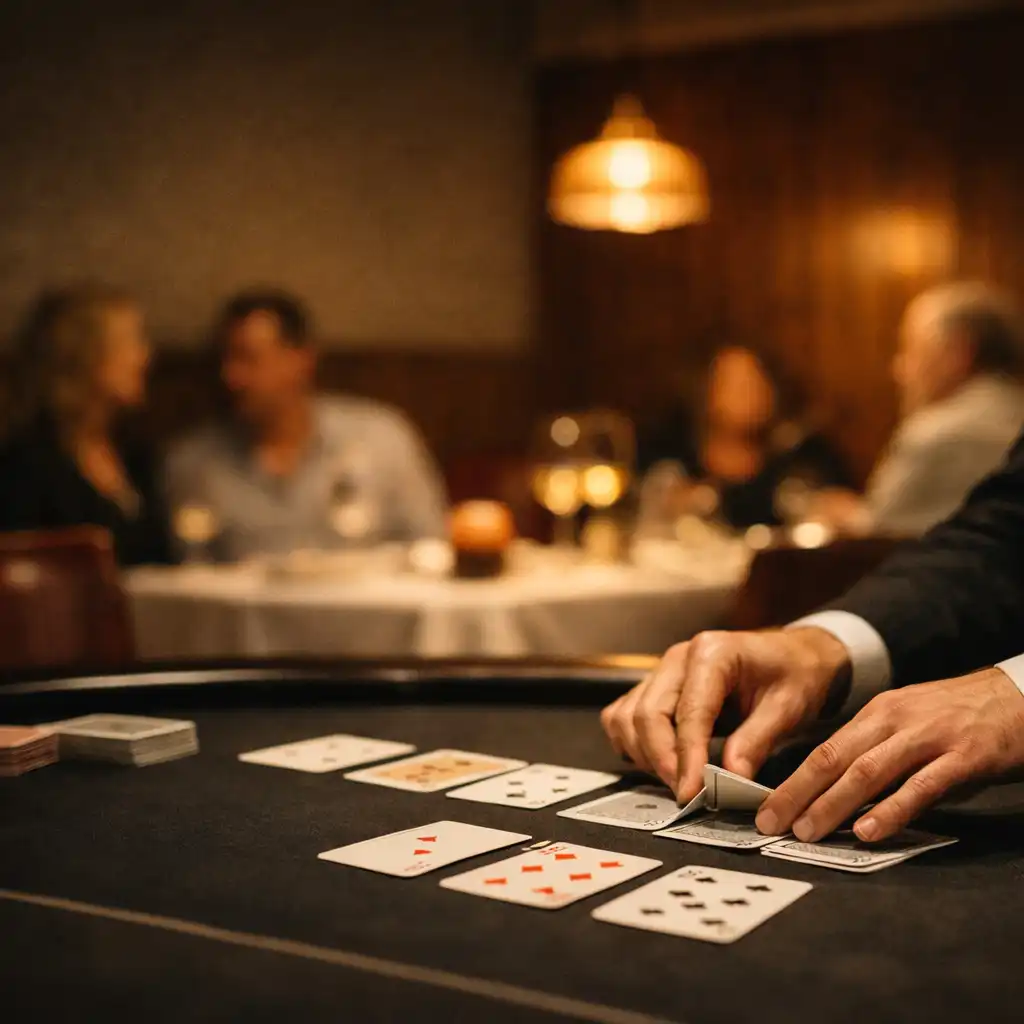
At Jubilee and Jack, poker is held physically at the restaurant: around real tables, in the card lounge and card rooms, with cards, conversation and dining sharing the same measured evening. This guide reads formats through room, hosting and rhythm—not rules or outcomes.
Every table is an in-person setting for hosted poker sessions and card evenings.
At an offline poker table, format starts before the first card is placed down. The scale of the table, the people gathered around it, the volume of the room and the attention a host can give all shape the feeling of play. In Jubilee and Jack’s card lounge and card rooms, poker tables are social arrangements: they decide what can be seen, how easily conversation travels, and when an evening can breathe.
That matters because poker here remains physical and face-to-face. A hosted poker session can make room for a pause in the dining room, a glance across the felt, or a conversation that continues while cards rest in hand. The table is not separate from hospitality; it is held within it.
This guide does not prescribe one best arrangement. It is a way to consider the tone you want to hold: conversational, focused, celebratory, or quietly gathered with your own familiar rhythm.
02 / Table geometry
Three ways a table can hold an evening
These are not fixed prescriptions. They are three useful ways to read the atmosphere of a physical poker table: the distance between people, the shape of attention, and the degree of occasion carried by the room.
Close table / Conversation-led
The close table
A close table keeps faces, hands, cards and conversation inside one shared field of attention. It suits an unhurried in-person card evening where the pleasure lies in noticing gestures and returning easily to a thought. In the card lounge, a host can help set a calm rhythm, allowing the table to feel held without turning it into a lesson or a spectacle.
Long table / Structured rhythm
The long table
A long table gives an evening a little more choreography. Sightlines, table ends and a host’s voice become part of the composition, while cards, conversation and food can move in a measured progression. In a card room, this format can carry a stronger sense of occasion without losing the ease of a restaurant gathering or the warmth of a shared table.
Room within room / Occasion-led
The room within the room
Sometimes the desired format is defined by a threshold: the movement from dining room into a card room, and the feeling that the group has found its own frame. This is a useful way to think about private gatherings—less as separation, more as a shared rhythm held within the wider restaurant atmosphere.
A simple reading key: proximity keeps conversation close; structure gives the evening a clearer line; privacy creates a more contained field of attention.
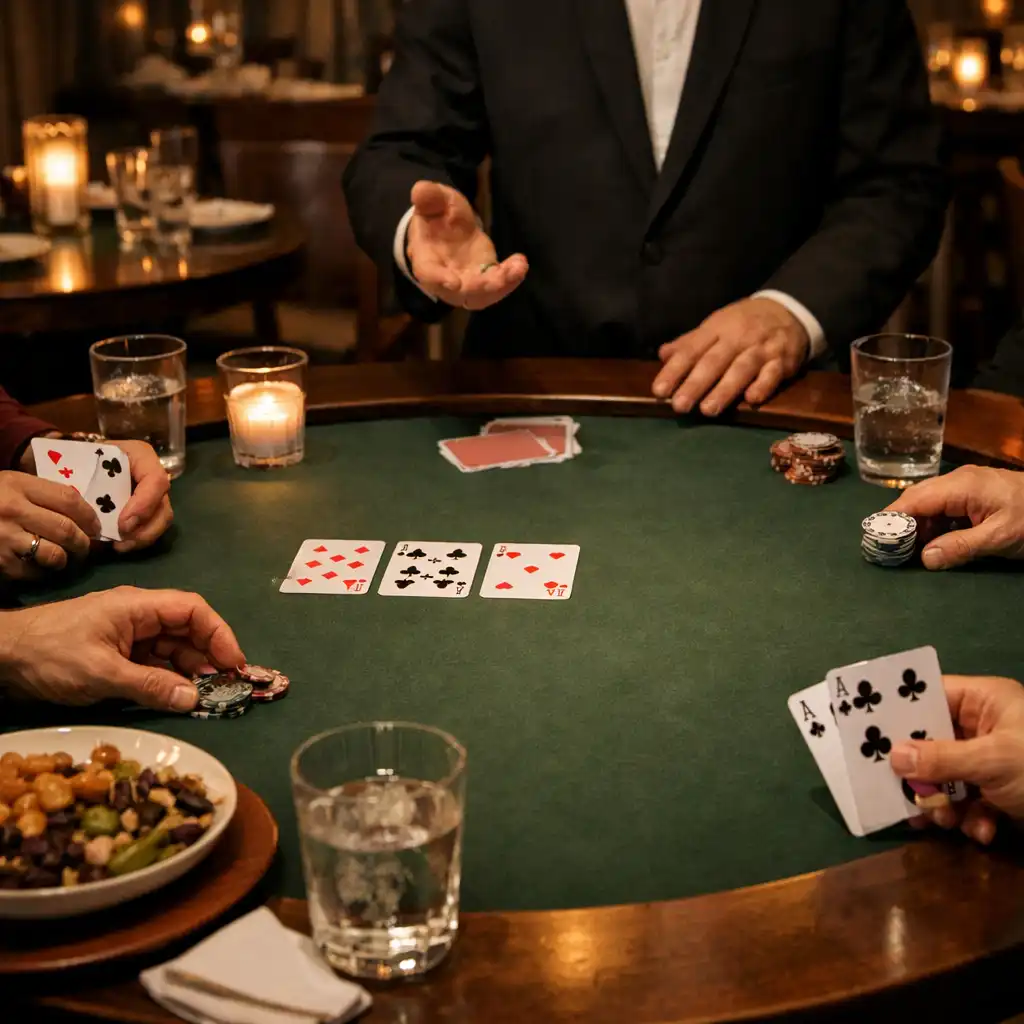
Hands, cards and shared plates create a circle of attention around a physical restaurant table.
03 / A closer field
When the table keeps everyone in the same conversation
A round or close-set table makes the social field immediately legible. Small gestures stay visible, pauses are shared rather than stranded, and the cards remain part of a larger exchange between people. In the card lounge, that proximity can give an in-person card evening an attentive, conversational texture without asking the room to become silent or formal.
The host’s presence is felt in the tone of the table: steady enough to keep the gathering clear, light enough to leave room for people to settle into their own conversation.
Hosted rhythm
The host’s role
A host acts as a quiet conductor, making room for welcome, cards, dining intervals and a return to the table. The movement between dining room and card lounge becomes part of the evening’s hospitality, rather than an interruption to it.
04 / Evening rhythm
An evening moves in more than one direction
01
Arrive into the room
The evening begins as a gradual move into the restaurant’s atmosphere. Whether the table sits near the card lounge or deeper in a card room, people can settle into the light, the conversation and the shared presence of the space before cards take focus. It is less an instruction than a change of attention: a gathering finding its place.
02
Let the evening find its pace
At the table, a host helps keep the rhythm legible while cards, conversation and a pause for dining coexist. The most satisfying pace is rarely urgent. It allows a thought to finish, a plate to arrive, a table to reset its attention, and the group to remain together through each shared interval.
03
Return to the table
After dining, returning to physical cards restores a thread that has not really been broken. Familiar faces, the table edge and the small ritual of dealing reconnect the group. The restaurant’s dual identity—as dining room and card setting—makes that return feel renewed while keeping the gathering unhurried.
An evening is carried by attention, not urgency: food, cards and conversation each taking their turn at the table.
05 / Setting and toneCard lounge
The card lounge keeps the restaurant in view
The card lounge remains connected to the restaurant’s wider hum. Light, the movement of people and the gentle presence of dining can remain part of the table’s story, making it a natural setting for evenings where the room around the cards matters as much as the cards themselves.
It is not about distraction. It is about proximity: the table retains a sense of occasion while still belonging to the broader texture of the restaurant.
The card room narrows the frame
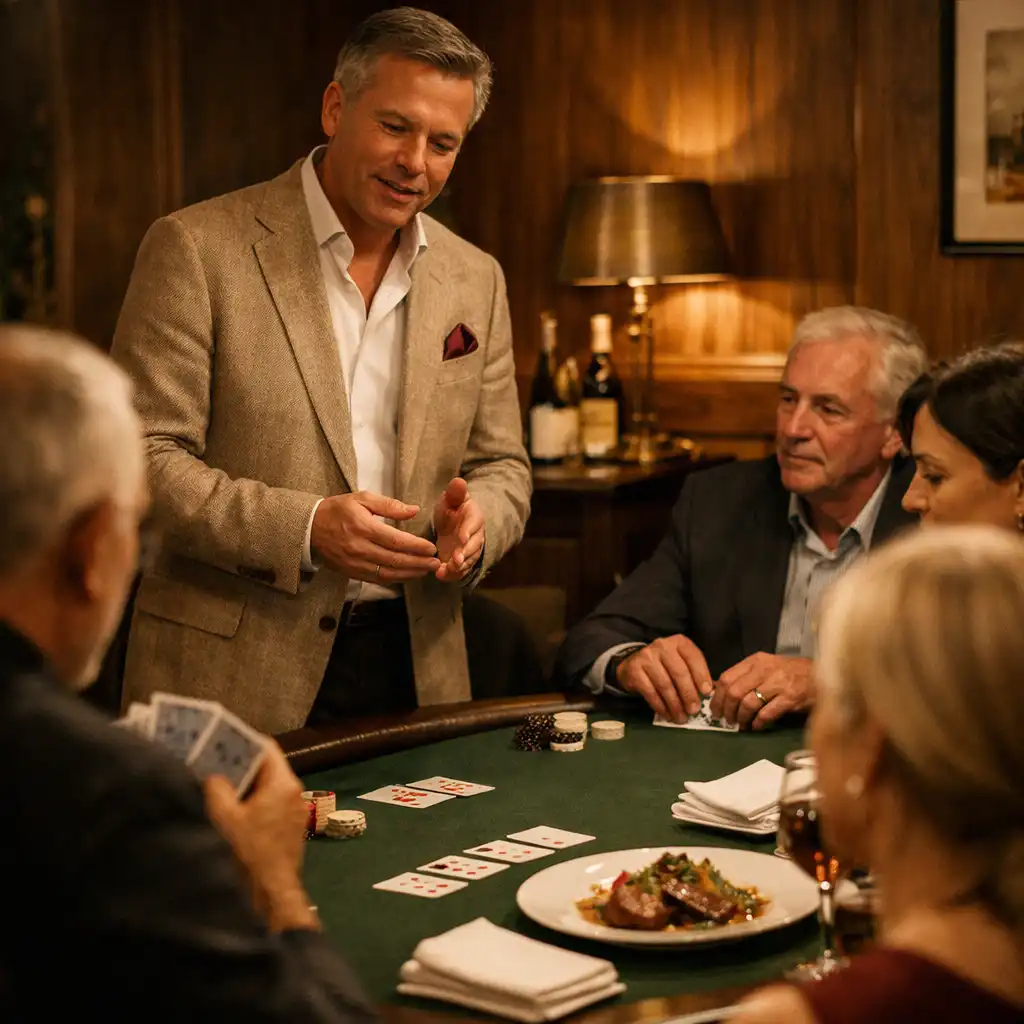
A card room creates a more contained field of attention. Here, the host, the table and the people gathered become the immediate frame, which can suit an occasion seeking concentration and a clearer shared focus. Neither setting is universally better; each changes how conversation, dining and physical cards meet.
A host, a table edge and dining cues hold a warm card-room scene in one quiet frame.
06 / Occasion-led choices
Choose the shape of the occasion
A table format becomes clearer when the gathering is considered first. These questions are not a selector; they are a way to name the balance between conversation, dining, hosting and the kind of frame your in-person restaurant evening may want.
What should stay at the centre of the evening?
If shared conversation is central, the close table may offer the most immediate field. If the group wants a clearer line and a host-led sense of progression, the long table may feel right. A card-room setting can add focus without deciding the tone for you; the question is what attention should gather around.
How present should dining feel?
Consider whether dining sits before cards, appears between moments at the table, or remains an ongoing part of the room’s atmosphere. There is no fixed sequence to choose. A useful format simply leaves enough space for the tempo of a meal to belong naturally beside the tempo of physical cards.
What kind of gathering are you holding?
A familiar group, a hosted card evening and a private occasion can each ask for a different frame. The card lounge and card room offer useful ways to think about connection and containment, while the table itself determines how people see, hear and return to one another throughout the restaurant evening.
From idea to occasion
When the desired rhythm is clear, continue the conversation through an in-person Reserve a table request or a Join a card evening enquiry.
07 / Continue the conversation
Let the table set the tone
A restaurant reservation and an in-person card evening can be considered together. At Jubilee and Jack, poker is held physically at the restaurant, and the format of the table helps set the tone for how food, cards, hosting and conversation meet.
Choose a clear next step for your restaurant occasion.